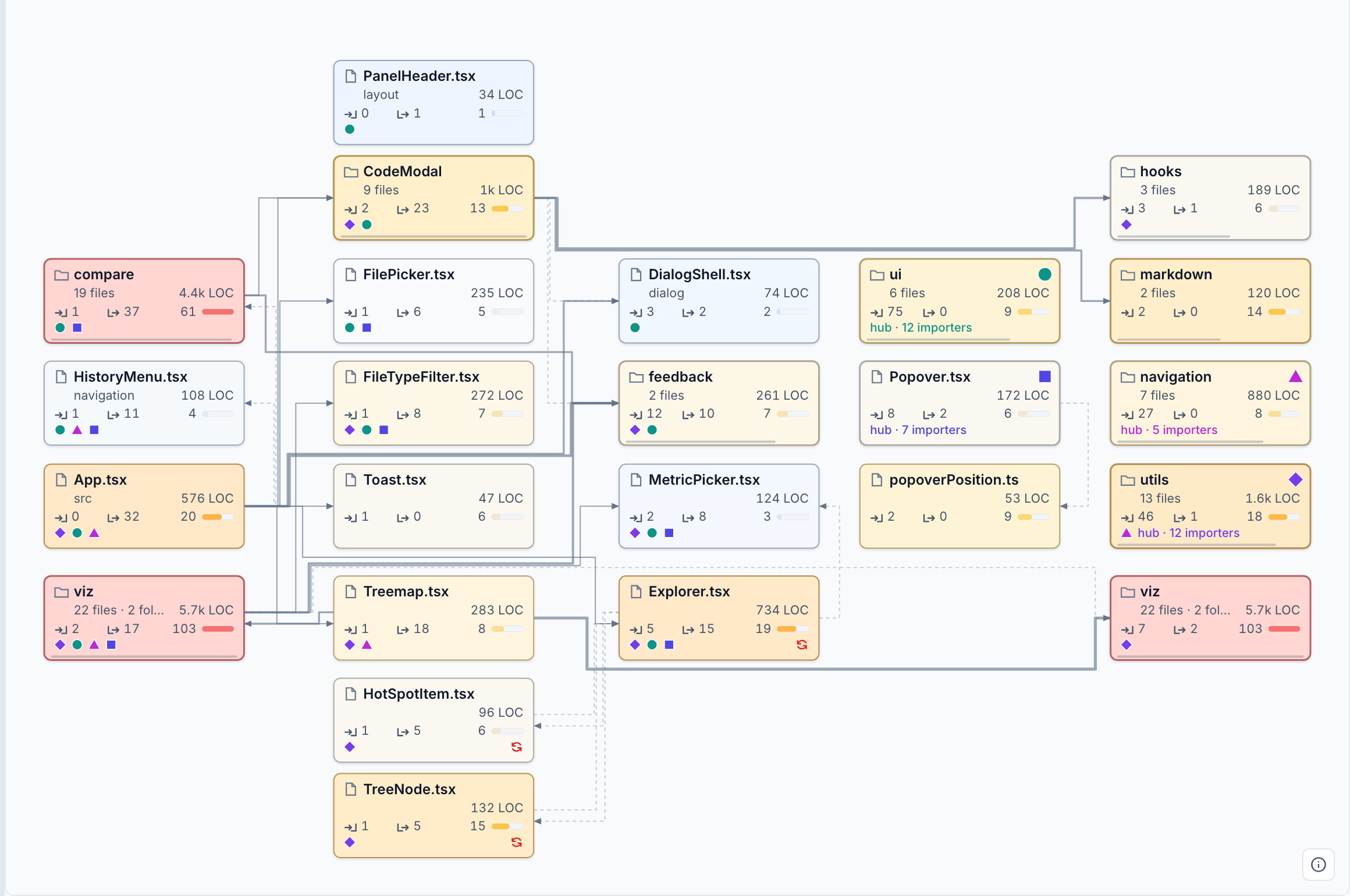
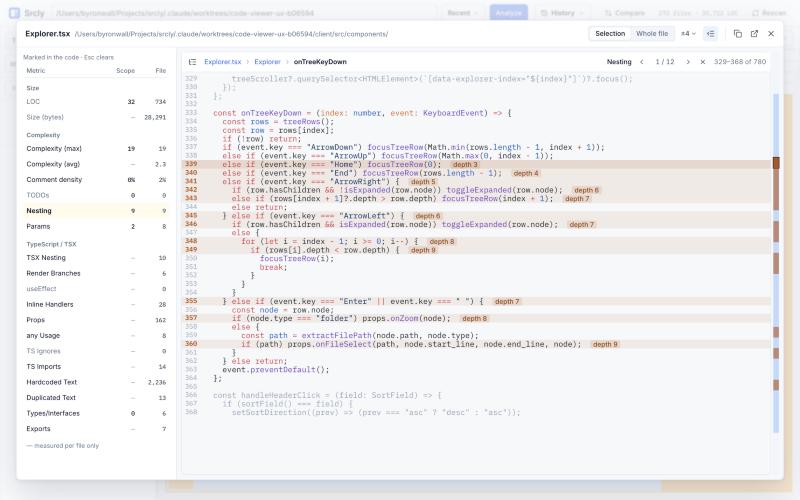
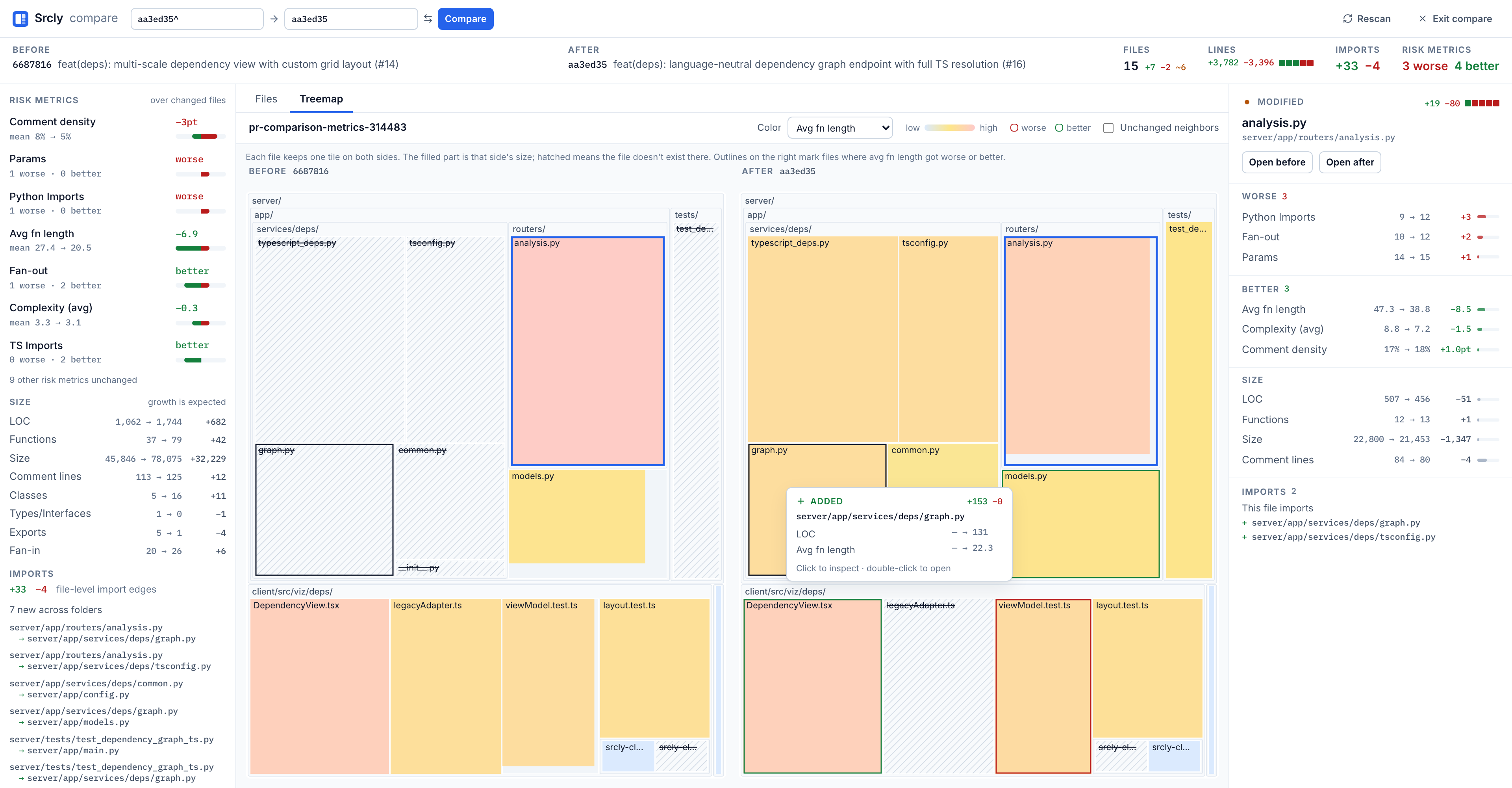
Srcly is a local-first tool for exploring codebases through a treemap, metrics, and code-flow views. It combines Lizard with tree-sitter analyzers to build a hierarchical model of folders, files, functions, and nested scopes, then renders the result as an explorable browser UI.
- Try it:
uvx srcly - Source: byronwall/srcly
Interface
How it works
Srcly runs as a FastAPI-backed local application with a SolidJS frontend:
- Static analysis:
- Uses Lizard for broad complexity and LOC coverage.
- Adds tree-sitter analyzers for TypeScript/TSX, Python, CSS/SCSS, Markdown, and notebooks.
- Extracts functions, nested scopes, complexity, comments, TODOs, imports, JSX signals, and language-specific quality metrics.
- Codebase model:
- Builds a folder/file/function tree that mirrors the repository structure.
- Represents nested scopes and remaining body fragments so treemap area does not double-count code.
- Aggregates metrics upward so folders and files can be sorted, colored, and ranked.
- Interactive UI:
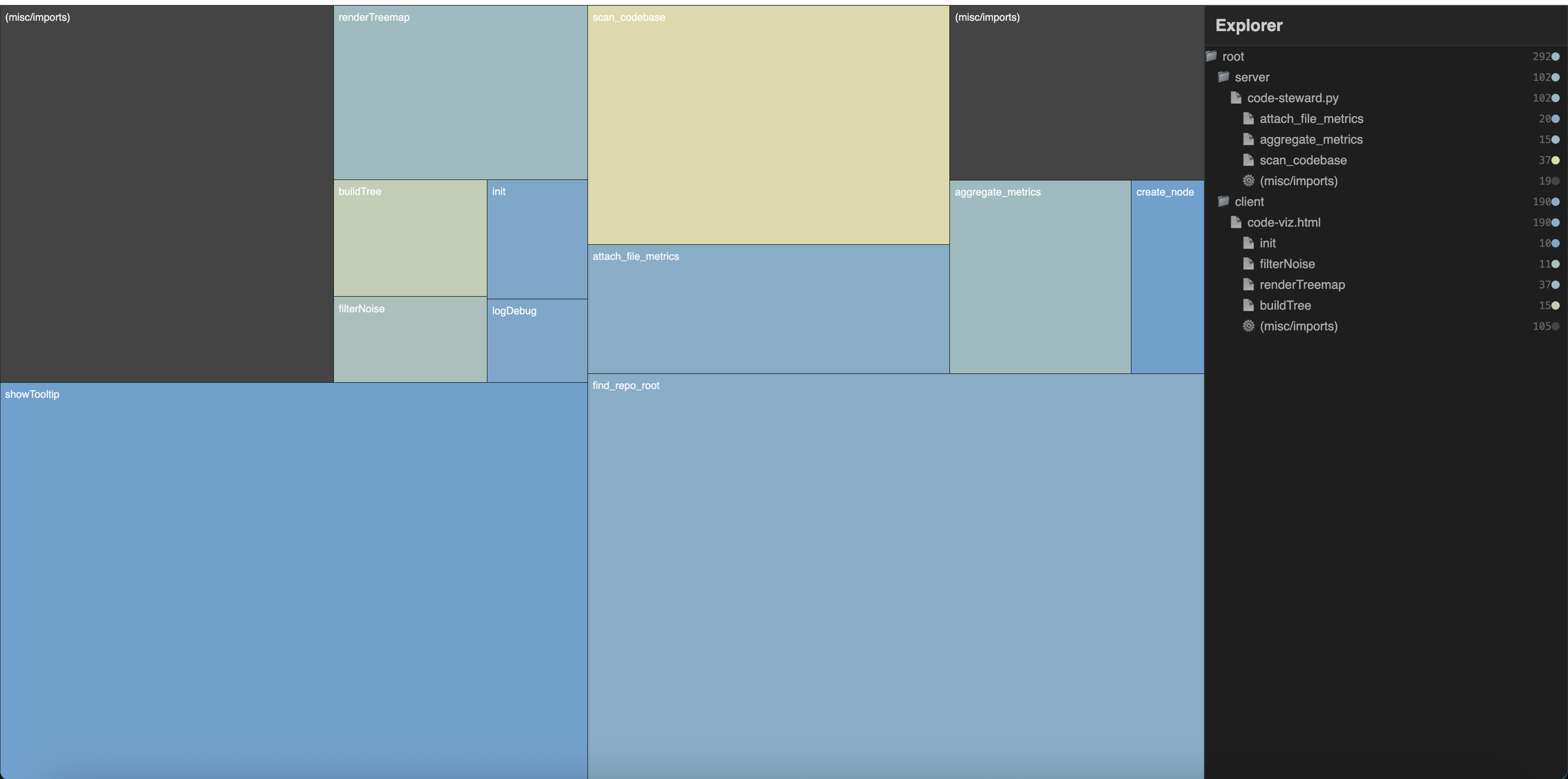
- Shows a LOC-sized treemap with selectable hotspot coloring.
- Provides an explorer sidebar with sorting, file-type filters, and Hot Spots ranking.
- Opens source in a syntax-highlighted code viewer with metrics, scope overlays, and flow views.
- Agent-ready reports:
- Supports headless commands for reports, hotspots, tree summaries, findings, and focused file explanations.
- Emits compact artifacts designed to help coding agents understand a repository before making changes.
Highlights
- One-command local usage with
uvx srcly - Treemap, explorer, and hotspot views backed by the same metrics model
- TypeScript/TSX dependency graph, scope flow, and data-flow inspection
- Source viewer with Shiki highlighting and Markdown/notebook previews
- Report mode for generating
report.md,findings.json, metric schemas, and compact tree summaries
Overview
Content coming soon.
Why it exists
Content coming soon.
Evolution and milestones
Content coming soon.
What changed
Content coming soon.
Lessons
Content coming soon.
What I would do differently
Content coming soon.
Next
Content coming soon.