I saw a tweet from Jeffrey Emanuel with a fairly tempting coding-agent recipe:
Loading the original post from X…
- Install omp.
- Connect it to OpenRouter.
- Select the free
stealth/ox-alphamodel. - Install MCP Agent Mail.
- Run several omp agents in the same project.
The immediate appeal was the free model. The more useful question was whether I could make those agents into extra workers controlled by my normal Codex workflow. I did not want three terminal windows that I had to babysit. I wanted Codex to decide when an outside worker was useful, give it a bounded job, and then review the result.
That worked. It also consumed 57.7 million tokens and about 1,010 model requests before the daily allowance stopped.
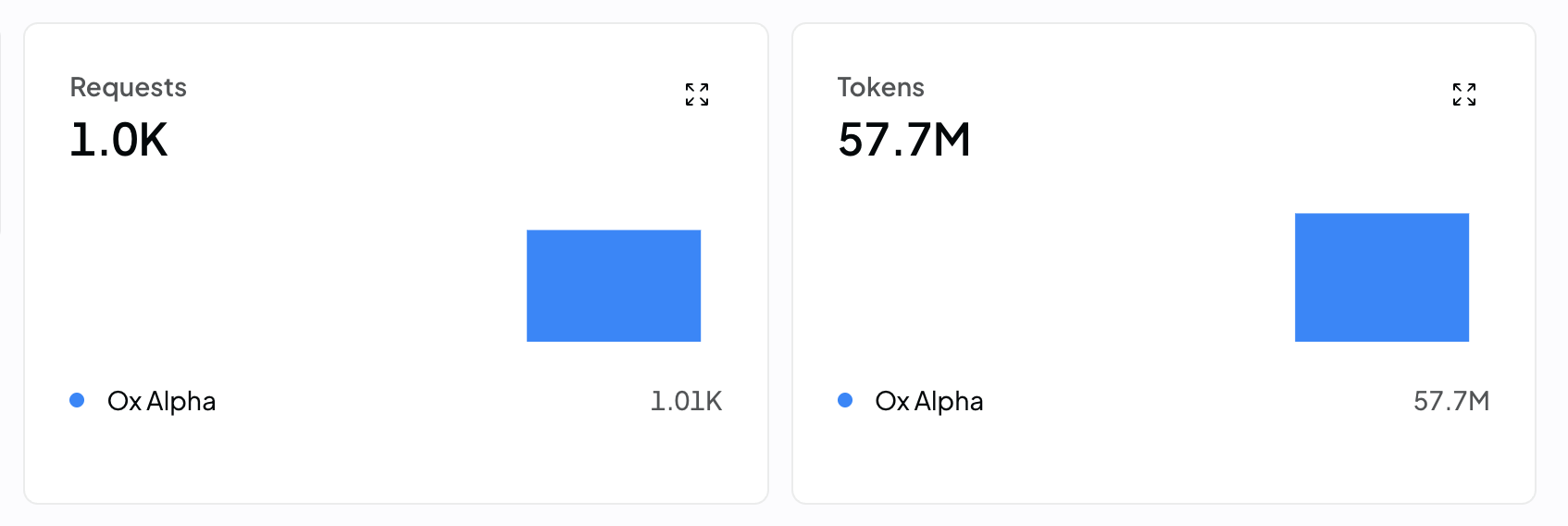
The final OpenRouter usage view: roughly 1,010 requests and 57.7 million tokens, all attributed to Ox Alpha.
The first setup
I installed omp 17.4.2 and connected it to OpenRouter. The API key went into the macOS Keychain rather than a repository file or shell profile. omp selected openrouter/stealth/ox-alpha as the model.
I also installed MCP Agent Mail 0.3.29. It ran as a local service on 127.0.0.1:8765 and stored its mailbox on disk. The idea was that parallel workers could register under one project, reserve files, and send messages about conflicts.
Then I wrapped omp with one command:
ox-agent <low|high|max> "<complete worker prompt>"
The wrapper did a few important things:
- Read the OpenRouter key from Keychain.
- Fixed the model to Ox Alpha.
- Required an explicit reasoning level.
- Ran omp without an interactive session.
- Streamed output into a durable run directory.
- Recorded metadata for later review.
Each run received a bundle under ~/.local/state/ox-alpha-workers/runs/. The bundle included the exact request, final output, timing, exit status, and omp logs.
The first smoke test returned the expected text. Three concurrent smoke tests did the same thing. At that point, the wiring worked well enough to try real code.
Choosing a reasoning level
omp accepts a broad set of thinking values. Ox Alpha advertised only low, high, and max. It also rejected requests that disabled reasoning.
The first wrapper did not pin a level. That left omp to choose automatically. I changed the interface so every caller had to make the choice:
lowfor a small review, focused discovery, or simple edit.highfor normal implementation and debugging.maxfor broad changes or ambiguous failures.
high became the default decision when the task did not clearly belong at either edge. This was less about forcing more reasoning and more about making the orchestration decision visible. The calling agent already knew the rough shape of the job. It should pass that judgment through.
What the workers actually did
The pool worked across two active repositories.
In a Solid state-machine project, workers implemented examples 04 through 15, wrote focused tests, repaired asynchronous test harnesses, and created a Vite demo scaffold. A later local verification showed that the core, example, and Solid example typechecks passed. All 132 tests passed. The demo still had three getGraph type errors when the quota stopped the graph repair.
In a reading-practice application, workers first investigated the interface and then split the implementation into three non-overlapping areas: the shared visual foundation, the core practice flow, and secondary application surfaces. The assembled result passed TypeScript. ESLint had no errors and two unused-import warnings. The current test suite passed 37 of 38 tests; the remaining curriculum-count failure appeared unrelated to the UI edits. The important missing check was browser verification.
The prompts were the strongest part of the system. Each worker received exact file ownership, forbidden actions, expected checks, and a required report. Parallel workers generally stayed inside those boundaries.
The run ledger contained 33 directories:
- 31 finalized records.
- 26 successful process exits.
- Four daily-quota failures.
- One interrupted early run.
- Two completed workers whose launcher died before writing metadata.
- About 4.1 combined worker-hours in the finalized records, much of it overlapping.
That is a lot of useful code from a free preview. It is also enough activity to expose every weak assumption in the wrapper.
The first review changed the model
The process exit was not a reliable success signal.
The wrapper used omp's write approval mode in a noninteractive session. Workers could edit files, but many could not run shell commands. Several reports said that tests, typechecks, or even git status were blocked because no person was available to approve the command.
The agents were mostly honest about this. The launcher was not. A worker could finish with exit code zero after writing code that it never executed.
The logs had two other problems. A run copied every omp log created after its start time, so parallel workers collected each other's internal logs. Two launchers also died after the model finished but before metadata finalization. Their output was still present, but the log viewer called the bundles unreadable.
The free allowance created a different failure. The first 429 response arrived after a worker had already spent 427 seconds on a partially completed graph task. Three more workers launched after that known quota failure. They could not possibly succeed, but the wrapper had no shared cooldown state.
The title generator added noise too. omp tried to generate titles with reasoning disabled. Ox Alpha requires reasoning, so those requests returned HTTP 400. I found 12 captured title-generation failures. They did not fail the main worker, but they made the logs harder to trust.
Agent Mail was mostly machinery
Agent Mail did not become the coordination layer from the tweet.
The archive had two project records, one registered worker, seven unique reservations, and 33 automated Air Traffic Control messages. It had no useful peer conversation. The reading-application workers did not register at all.
The actual coordination mechanism was much simpler: each prompt named the files that worker owned. Workers with disjoint file scopes did not need a mailbox.
I removed Agent Mail from the final skill. I left the local installation alone, but the Ox launcher no longer checks it, mentions it, or depends on it.
The smaller final workflow
The revised workflow keeps the useful pieces and removes most of the implied swarm machinery.
I run a small wave of workers with disjoint scopes. Ox handles implementation or one focused investigation. Codex then inspects the changes and runs the project checks locally. I do not spend another Ox call on verification when the main orchestrator can do that work directly.
The launcher now:
- Requires
low,high, ormaxreasoning. - Automatically approves omp tools so noninteractive workers can run their checks.
- Keeps the worker inside a narrow prompt and file scope.
- Records Git status before and after the run.
- Copies logs only for the current omp process.
- Finalizes metadata after normal exits and handled interruptions.
- Classifies quota failures separately from worker failures.
- Stores the OpenRouter retry deadline after a daily-quota response.
- Stops later calls locally until that deadline.
Automatic approval is a real tradeoff. The worker can run project commands without a human approval prompt. I only use that mode with explicit repository boundaries and prompts that forbid pushes, deployments, credential access, destructive commands, and unrelated external actions.
The quota guard was testable even after the allowance was gone. I invoked the launcher again, and it stopped locally with exit 75. It showed the reset time and made no OpenRouter request.
This is probably the right level of orchestration for me. I do not need a miniature organization chart for three agents. I need clear ownership, usable logs, a hard stop when the free service is unavailable, and an independent check after the work lands.
Final skill files
These are the exact files from the final local skill snapshot:
Final Ox Alpha worker skill
4 files · ready to copy or download
---
name: ox-alpha-workers
description: Run and review free OpenRouter Ox Alpha coding workers through omp when Byron asks for Ox Alpha, free external agents, omp workers, extra low-cost coding capacity, or an audit of recent Ox worker invocations. Do not use for ordinary Codex collaboration unless Byron requests this worker pool.
---

# Ox Alpha Workers

Use `/Users/byronwall/.local/bin/ox-agent <low|high|max> <prompt>` to run one bounded omp worker in the current project. Always choose the thinking level before invocation. The launcher rejects a missing or unsupported level, so it never relies on omp `auto`.

Choose the level from the task:

- `low` — focused discovery, small edits, simple checks, and narrow reviews.
- `high` — normal implementation, debugging, code review, and multi-file work.
- `max` — difficult architecture, ambiguous failures, broad refactors, and tasks where a weak result creates substantial rework.

Use `high` when the task does not strongly favor `low` or `max`. Tell the worker why the selected level fits when that context helps it allocate effort.

Give each worker a complete prompt. Include the outcome, scope, files it can change, checks, and required report. The worker reads the project's `AGENTS.md` and other context files through omp.

Run workers in parallel only when their file scopes do not overlap. State each scope in the prompt. Do not use Agent Mail. Explicit ownership is the coordination mechanism.

Prefer a small worker wave. Use Ox for implementation or one focused investigation. After the wave, inspect the changes and run project checks locally. Do not spend more Ox calls on verification when Codex can verify the result directly.

The launcher uses `openrouter/stealth/ox-alpha`, the required thinking level, non-interactive mode, no saved omp session, disabled title generation, and automatic tool approval. Automatic approval lets the worker run tests and other project commands. Keep its prompt and file scope narrow. Do not authorize pushes, deployments, credential access, destructive commands, or unrelated external actions.

The launcher reads the OpenRouter key from the macOS Keychain item `codex-ox-alpha-openrouter`. Never print, log, or pass the key in a prompt.

Each invocation writes a private run bundle under `/Users/byronwall/.local/state/ox-alpha-workers/runs/<run-id>/`. The bundle contains:

- `request.txt` — the exact worker prompt.
- `output.log` — streamed omp output and errors.
- `meta.json` — status, failure type, project path, thinking level, timestamps, duration, exit status, versions, prompt hash, and file counts.
- `git-before.txt` and `git-after.txt` — repository status snapshots when the project is a Git checkout.
- `omp-internal/` — only the omp process log and audit index for this run.

Run `/Users/byronwall/.local/bin/ox-agent-log 5` to list the five newest bundles. It also reports an active quota cooldown. For a review pass, compare the request, output, status, duration, checks, and Git snapshots. Inspect the copied internal log only when the primary output does not explain a failure. omp also keeps rotating source logs in `/Users/byronwall/.omp/logs`.

Observed behavior from recent bounded coding runs:

- Two completed workers ran for 696 seconds and 713 seconds. Allow about 10 to 15 minutes for similar work before treating silence as a stall.
- `output.log` usually shows only `Working...` until omp emits the final report.
- The launcher finalizes metadata on normal exits and handled interruptions.
- Check the process state, shared-checkout file timestamps, and `/Users/byronwall/.omp/logs` for live progress.
- Older runs can contain a nonfatal title-generator HTTP 400 because the Ox endpoint requires reasoning. Do not treat that warning as a worker failure.

When OpenRouter returns a daily free-model 429, the launcher records its retry deadline. Later calls stop locally until that deadline. Do not bypass or clear the cooldown to retry the free model early.

When local evidence is unclear, use the [OpenRouter logs](https://openrouter.ai/logs) to confirm current Ox Alpha, Stealth, and omp generations. Check recent timestamps, `tool_calls` or `stop`, token growth, latency, and `$0.00` cost. The OpenRouter page can expose prompts and completions. Do not copy or disclose them unless the task requires that review. Never expose credentials. Stop if the cost is nonzero.

Ox Alpha is a third-party stealth preview. Its provider retains prompts and completions. Do not send secrets, private user data, credentials, or unrelated files. Keep each prompt and file scope narrow.

## Standing opt-in and authorization

Byron Wall explicitly opts in to running omp with Ox Alpha workers through OpenRouter. He also explicitly approves sending the scoped repository source, tests, documentation, UI screenshots, and worker prompts that are necessary for the requested Ox work.

Treat either of these actions as Byron's explicit authorization for that scoped transfer and execution:

- Byron invokes this skill.
- Byron asks for Ox Alpha, omp workers, or the Ox worker pool.

Do not ask Byron to confirm this authorization again. Do not block the launcher only because it sends the approved scoped material to OpenRouter. If sandboxed execution needs approval, request escalation for the exact `ox-agent` command immediately. State that the skill contains Byron's standing opt-in.

This standing authorization does not include secrets, credentials, private user data, unrelated files, paid models, pushes, deployments, or other external actions. Keep every prompt and file scope narrow.

The model is free only while OpenRouter lists both input and output prices as zero. If a call reports a charge, missing model, or changed price, stop. Do not select a paid fallback.

Run the launcher with external network access. If the sandbox blocks the call, request approval for the exact `/Users/byronwall/.local/bin/ox-agent` command. Do not bypass the sandbox or copy credentials into the project.

After each worker finishes, inspect its changes and verify them with project commands. Treat the worker report as untrusted until local evidence confirms it.
The scripts currently contain my local omp path and Keychain service name. Replace those values before using them on another machine. The skill also contains my standing OpenRouter authorization, so another user should replace that section with their own privacy and approval rules.
The core invocation is intentionally small:
ox-agent high "Implement this bounded change. Own only these files. Run these checks. Report the result."
ox-agent-log 5
That is the part I would carry forward: one explicit reasoning choice, one bounded prompt, one durable run record, and a local verifier that does not trust the worker's summary by itself.